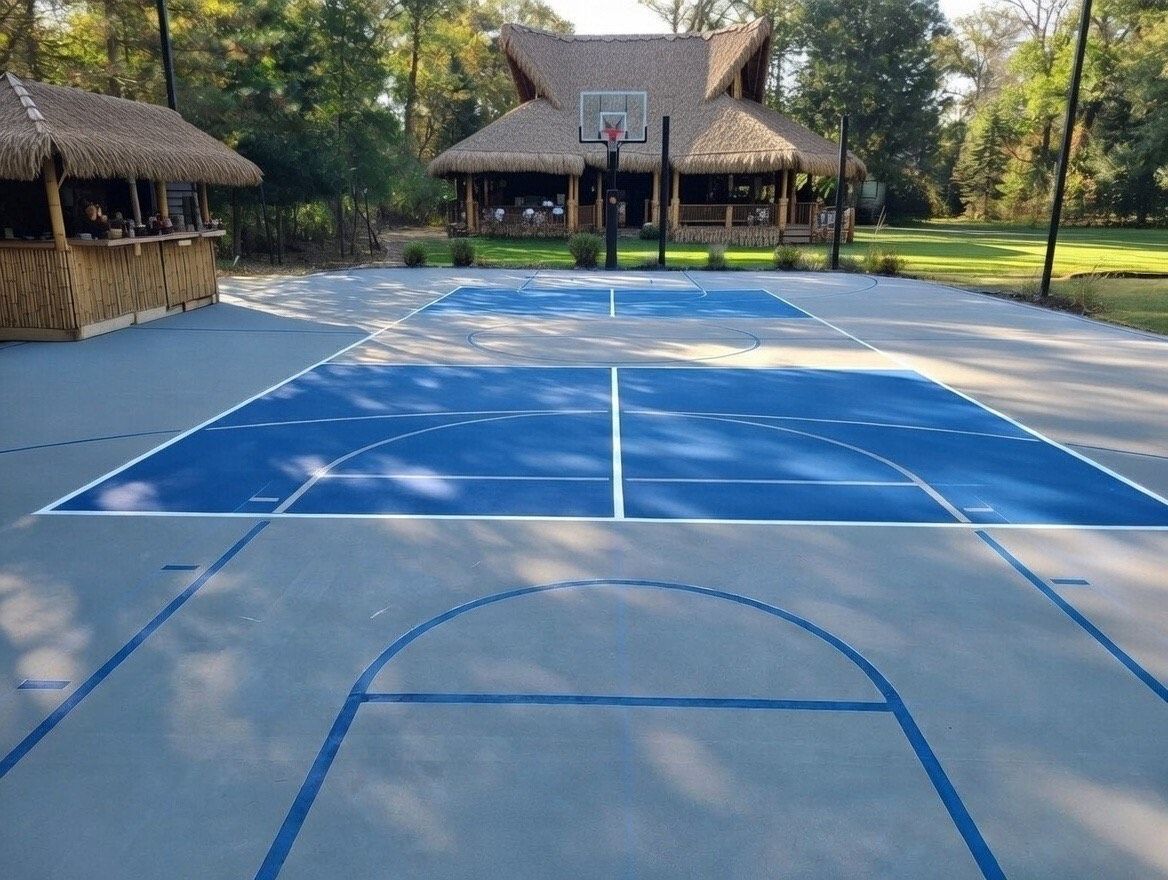

Standing Water or Birdbaths on Your Court After Rain? What's Causing the Low Spots
Quick Answer: A "birdbath" is court-industry shorthand for a spot where rainwater sits instead of running off, and by the American Sports Builders Association's own definition, any puddle deeper than 1/16 inch that hasn't drained or dried within an hour of direct sun counts. Most low spots trace back to what's happening below the surface: soil that settled unevenly, a base that never had enough pitch to begin with, or ground that shifted after a hard freeze-thaw winter. A single small birdbath under a half-inch deep is usually a simple patch. Multiple puddles, or any depression pushing past a half-inch, points to a base problem that patching alone won't solve for long. The right fix depends less on the puddle itself and more on what's happening underneath it.
You walk out to the court the morning after a storm and there it is again — the same oval of water sitting just past the baseline, refusing to soak in or run off the way the rest of the surface already has. Maybe you've swept it, squeegeed it, or let it sit in full sun for an hour hoping it would burn off. It's still there. A day later someone's shoe skids through it mid-rally, or a ball takes a dead bounce right where the water pooled and dried into a faint ring.
That ring on the surface is the real tell. The puddle itself isn't the problem — it's a symptom of something that happened to the ground underneath, in a spot you can't see and probably never thought about until the water started collecting there.
What Actually Counts as a Birdbath
Every outdoor court has some texture to it. No paving or coating process, even laser-guided, produces a surface that's perfectly flat across thousands of square feet, and it isn't supposed to.
The Industry Definition
The American Sports Builders Association defines a birdbath as an area where standing water deeper than 1/16 inch remains after the court drains, or where water fails to dry within one hour of direct 70-degree sunlight. This distinction separates genuine drainage defects from normal surface wear.
What's Within Tolerance, And Why The Line Matters
A shallow depression that drains naturally or dries within an hour usually isn't worth repairing. Courts settle gradually, and minor unevenness can remain acceptable. Understanding the difference prevents unnecessary repair costs and downtime while helping you address serious low spots before they cause staining, peeling, or coating damage.
Why Low Spots Form in the First Place
A court doesn't develop a birdbath out of nowhere. The surface layer — whether it's asphalt, an acrylic coating over concrete, or a cushioned system — is only as flat as the base underneath it, and that base is where most low spots actually start.
Uneven Soil Compaction
If the subgrade wasn't compacted evenly during original construction, certain pockets settle more than others once the court has a few seasons of traffic, sun, and moisture behind it. The surface follows the ground down.
Insufficient Original Slope
Courts need enough pitch built into the base for water to actually leave the surface instead of collecting on it. Guidelines from the U.S. Tennis Court and Track Builders Association call for surface grades of roughly half a percent on paved court surfaces — not much, but without it water has nowhere to go and it finds the lowest point instead.
Aging Surface Material
Asphalt binder and acrylic coatings both lose some flexibility with age and UV exposure. As the material stiffens and shrinks slightly, it can settle unevenly into whatever small variations already exist in the base below it.
Root Intrusion And Buried Utilities
Tree roots growing under or near a court, or a trench that was backfilled differently than the surrounding soil during a utility installation, create pockets that settle at a different rate than everything around them.
Where a Minnesota Winter Fits Into This
Central and Northern Minnesota courts deal with a factor that warmer climates never have to think about: repeated freeze-thaw cycling in soil that's often heavier in clay and silt than sandy or gravelly ground.
How Frost Heave Works
When freezing temperatures reach fine-grained, moisture-holding soil, ice crystals form and grow into layers called ice lenses, drawing in more water through capillary action as they expand. That growth pushes the ground — and whatever sits on top of it — upward. Engineering references on pavement design identify frost-susceptible soil, freezing temperatures, and available water as the three conditions that combine to cause this kind of heave.
Why It Creates Low Spots Instead Of Just Cracks — And Why Spring Makes It Worse
Heaving rarely happens evenly across an entire court. It's more pronounced where soil conditions change — near a buried drain line, along a spot where fill material differs from the surrounding ground, or wherever moisture tends to collect underneath the base. That uneven, or "differential," heaving is what leaves one section of a court sitting slightly higher or lower than the rest once everything settles back down. Then spring adds a second hit: as the frozen ground thaws, the soil that held those ice lenses temporarily loses strength and bearing capacity while the excess water works its way out. A court that seemed stable in January can develop a soft spot by April simply because the ground underneath spent a season expanding, contracting, and losing structure in the process.
Courts that go through a full Minnesota freeze cycle every year are, by nature, working against a moving target underneath the surface. That's not a reason to expect constant repairs — a properly built base is designed to handle this — but it does explain why even a court that played true for years can suddenly start holding water in a new spot.
TIP: After spring thaw, walk the court with a garden hose or wait for the next real rain and watch where water actually collects rather than guessing from memory. Low spots often shift slightly from year to year as the ground keeps settling, so this year's puddle map won't always match last year's.
Reading the Size and Pattern of the Puddle
Not every birdbath tells the same story, and the pattern matters as much as the depth.
One Small, Shallow Spot
A single depression under a half-inch deep, especially one that's stayed the same size for a season or two, usually points to a localized settling issue that a surface-level repair can address directly.
Multiple Spots Across The Court
When water collects in several places, especially in a pattern that runs along one side or corner of the court, it often signals a broader slope or drainage issue built into the original grading rather than isolated settling.
Depressions Deeper Than A Malf-Inch
Deeper low spots are harder to correct and more likely to return. They usually point to a more significant shift in the base material, not just a surface-level dip.
Puddles That Follow A Straight Line
Water pooling in a line across the court, rather than in an isolated oval, often traces back to a buried trench, drain, or utility run beneath that section — exactly the kind of differential settlement that forms where backfill material differs from the surrounding soil.
What Repair Actually Involves
Fixing a birdbath sounds simple — fill the low spot, level it out — but the materials involved have real limits worth understanding before you decide on a repair.
Patch materials and their limits
Asphalt resurfacers and acrylic patch binders are both water-based, and they need to cure through proper drying and weather conditions before they reach full strength. They can typically be built up to an effective depth of about a half-inch in a single application, which is part of why deeper depressions are harder to correct in one pass.
Why shrinkage happens, and why a second visit isn't a red flag
As those water-based patch materials dry, they lose volume slightly. A repair installed perfectly flush with the surrounding surface can settle back into a shallow depression once it's fully cured. Getting a patch to sit level, cure properly, and hold through the next rain sometimes takes more than one visit, particularly on a repair done outside the warmest, driest stretch of the season — that's a normal part of doing the leveling work correctly rather than rushing a fix that won't last.
When a Patch Isn't the Right Answer Anymore
A single birdbath is usually a repair job. A court with several is a different conversation.
Multiple or major depressions
Once a court has several birdbaths, or any single depression approaching or exceeding a half-inch, it often points to a base-level problem that individual patches can only manage rather than solve. Patching each spot separately tends to leave a surface with visible seams and inconsistent color, since new material rarely matches aged coating exactly.
WARNING: Skipping a proper condition assessment and just patching visible puddles can mask a deeper base problem for a season or two, but the same low spots — or new ones nearby — tend to reappear once the next freeze-thaw cycle works on the same weak point in the ground.
Overlay or reconstruction — matching the fix to the damage
For courts with widespread but not severe settling, an overlay system built on top of the existing surface can restore a consistent slope without removing everything down to the base, resetting the drainage picture without a full rebuild. But if the base itself never had the right pitch, drainage, or compaction to begin with, no amount of surface patching solves that permanently. In that case, rebuilding the base with correct grading is the only fix that holds up over multiple winters instead of one.
Building Drainage In From the Start
Water needs a clear, continuous path off the court whether you're fixing an existing birdbath or planning a new build, and that path has to be engineered into the grading — not left to chance.
Surface slope guidelines
Construction guidelines call for a minimum pitch on paved surfaces of roughly half a percent, with swales and collection areas around the perimeter graded even more steeply to actively move water away rather than let it sit at the court's edge.
Perimeter drainage, and why grading beats extra base material
On sites with heavier clay soil or a naturally high water table — common across parts of Central Minnesota — a perimeter drainage system intercepts groundwater before it ever reaches the base beneath the court, reducing the moisture available to form ice lenses in the first place. Piling on more base rock or a thicker overlay doesn't fix a drainage problem caused by poor original grading; correct, consistent pitch throughout the subgrade and subbase is what keeps water moving, no matter how much material sits above it.
Frequently Asked Questions
How deep does a puddle have to be before it's actually a problem?
Anything under 1/16 inch that drains or dries within about an hour is considered normal and not worth repairing. Once a puddle holds water deeper than that for longer, or keeps reappearing in the same spot after every rain, it's worth having someone look at what's happening underneath.
Will a birdbath come back after it's been patched?
It can, especially if the ground beneath it is still settling or the patch material shrinks slightly as it cures. A properly done repair reduces how often and how severely the water collects, but if the underlying soil movement hasn't stopped, the same low spot can reappear in a future season.
Does one birdbath mean the whole court needs to be rebuilt?
No. A single, shallow low spot is typically a localized issue that a targeted patch handles well. Rebuilding usually only becomes necessary when multiple depressions show up across the court or when a single low spot runs well past a half-inch deep.
Can I test for a birdbath myself?
Yes. After a rain, wait until the rest of the court has stopped draining and check any remaining wet spots with a coin — a nickel is roughly 1/16 inch thick. If water still covers the coin after an hour of direct sun, it meets the industry definition of a birdbath.
Why does my court have new low spots that weren't there last year?
Ground continues to shift after construction, especially through repeated freeze-thaw cycles. A spot that drained fine for several seasons can start holding water once the soil beneath it settles further or a nearby area heaves slightly during a hard winter.
Does resurfacing fix drainage, or just the look of the court?
A standard resurfacing addresses the coating and minor leveling, but it won't correct a slope problem built into the base. If low spots are widespread, drainage improvements need to be part of the plan, not just a fresh layer of color on top.
What Your Court's Low Spots Are Telling You
A birdbath is information, not just an inconvenience. It's the ground beneath your court reporting where it settled, where the original grading fell short, or where last winter's freeze cycle pushed things slightly out of alignment. Reading that correctly, checking depth against the nickel test, noting whether it's one spot or several, watching whether it returns in the same place year after year, tells you far more about the court's health than staring at the puddle ever will.
Outdoor Specialties
has spent 100
years of combined experience working on courts across Central and Northern Minnesota, and that history keeps pointing to the same lesson: the base decides everything the surface eventually shows. A court built with proper pitch, sound compaction, and drainage suited to a Minnesota winter rarely develops a birdbath worth worrying about. One that skips those fundamentals keeps telling the same story, storm after storm, until the ground underneath finally gets the attention it's been asking for.